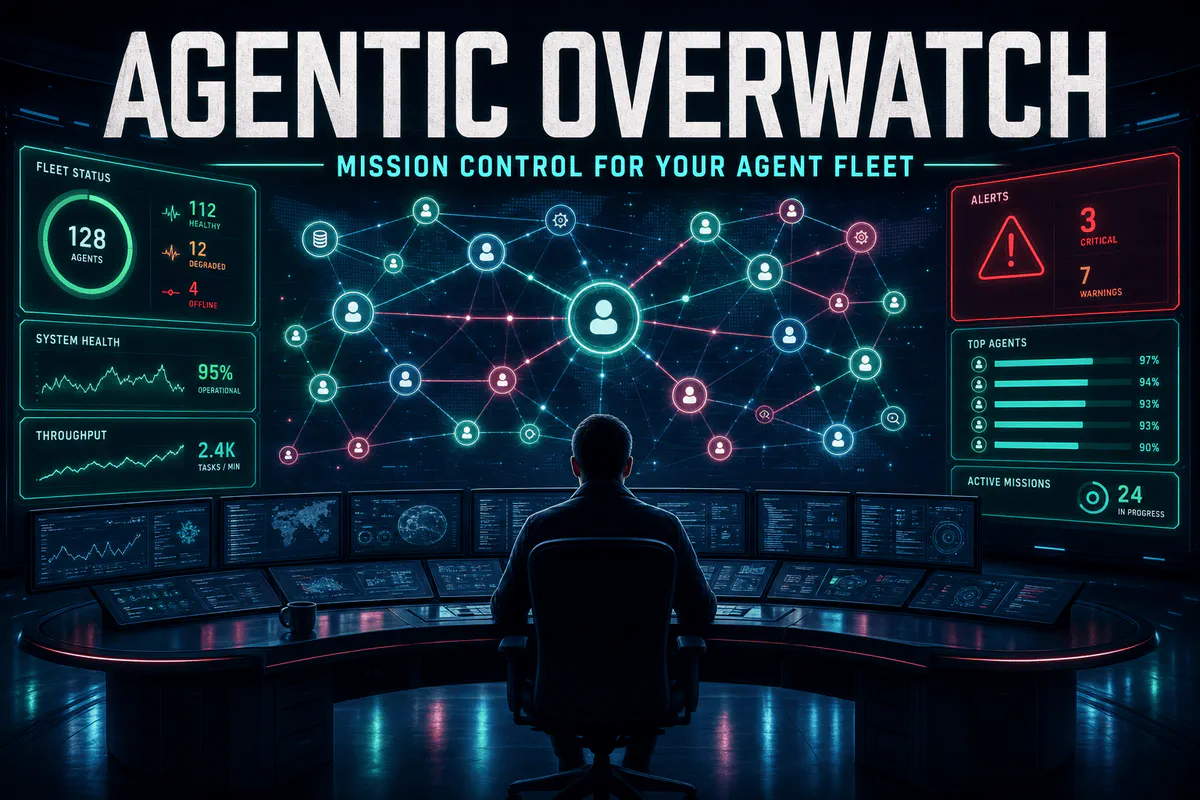
It’s 3:00 AM and a dozen screens are still on. Most of the company is asleep. A few people aren’t, because the systems they watch don’t keep office hours. A graph spikes red, someone acknowledges the alert, a fix goes out, the line settles back to green. Then the next one.
Early in my career I spent less than a year inside a Network Operations Center like that. Short stint, but it stuck with me. We kept thousands of live servers running in real time, 24/7. When something broke at 3:00 AM we didn’t file it for the morning stand-up. We fixed it then and there. We were the failsafe, and the failsafe doesn’t get to sleep through the incident.
I keep coming back to that room, because I think it’s where the whole software industry is heading. Not just engineering. All of it.
Here is the part most people haven’t clocked yet. The agents everyone is so excited about don’t only write code. Inside the organizations that are actually leaning in, one agent is rebalancing cloud spend before the monthly bill blows the budget. Another just quarantined a leaked token and is drafting the security writeup. A third is rewriting the flaky test suite that’s been blocking the release train. A fourth shipped the incident postmortem before the humans woke up. A fifth is halfway through a customer’s support ticket. None of them asked permission. Every one of them is doing work that used to belong to a person with a title.
That isn’t a dev team anymore. It’s a workforce. And almost nobody has a single screen that shows what the whole workforce is doing right now.
We are handing autonomous agents the keys to engineering, operations, security, QA, data, and support, at a velocity no human team can match. And we are still governing them with the model we built for hand-typed software: nine to five, five days a week, with a fragile on-call rotation taped to the side. We still expect a tired human to “step up” at 2:00 AM and babysit production.
That expectation was already shaky when humans wrote all the code. It snaps the moment the code, the infra changes, the security responses, and the test rewrites all start writing themselves.
You cannot govern a workforce that runs flat out, around the clock, with a team that logs off at 5 PM.
We are entering the era of Agentic Overwatch.
Defining the term#
I want to say plainly what I mean, because the industry keeps gesturing at this without naming it.
Agentic Overwatch is the discipline of supervising a fleet of autonomous AI agents in production the way an operations center supervises live infrastructure. A NOC watches uptime. A SOC watches threats. Agentic Overwatch watches the agents themselves, whatever function they happen to be performing, and keeps a human in the loop for the decisions that carry real consequences. Continuous, tiered, shift-based. The unit of work is no longer a line of code. It is the fleet, and the human’s job is to steer, judge, and authorize rather than type.
That is the whole idea. Everything below is the architecture of it.
The room needs a name too, because it earns one. A NOC is a Network Operations Center. A SOC is a Security Operations Center. This is the Agent Operations Center, the AOC, and the people who staff it are the AOC team. That is what I mean every time I say “the room” from here on.
A couple of things it gets confused with, so let me clear them out of the way.
It is not AIOps or observability. Those tools watch your systems and surface anomalies for a human to go fix. Overwatch watches your agents, the workers that are themselves taking action, and a human approves or vetoes what they propose. The thing under supervision moved up a level. Your dashboards used to show you CPU and latency. Now they have to show you what your workforce is deciding to do about CPU and latency.
It is also not vibe coding. Vibe coding is the casual, almost magical act of prompting an AI to spit out an app while you sip your coffee. Fun trick. It completely ignores what happens after the demo, when that code scales and thousands of agents are making real decisions in a live environment at once. Vibe coding is about generating. Overwatch is about governing. They are not in the same job family.
And to head off the obvious question: yes, a few security vendors ship products with “OverWatch” in the name for threat hunting. This is broader than any one product. Agentic Overwatch is not a thing you buy. It is the operating model for supervising your whole agent fleet, whatever job it happens to be doing.
It was never just about code#
The phrase “AI writes code” undersold this from the start. Code was simply the first job agents got good enough to take.
Watch where they spread next, because it is already happening. In operations, agents scale services up and down, reroute traffic, and roll deployments back when error rates climb. In security, they triage alerts, revoke credentials, and isolate compromised workloads. In QA, they generate tests, reproduce bugs, and gate releases. In data, they fix broken pipelines and backfill tables. In FinOps, they hunt down waste and right-size infrastructure. In support, they resolve tickets that used to sit in a queue for two days. Each of these is a function that an entire team used to own. Now an agent owns a slice of it, and the slice keeps growing.
I wrote a while back about putting AI agents on the org chart, with real owners and real KPIs. The point lands harder now. If agents staff every function, then the most dangerous failures are not the ones inside a single function. They are the ones that cross between them. The cost agent right-sizes a database at the exact moment the deploy agent ships a migration against it. The security agent revokes a service account that, three systems away, runs the nightly search-index rebuild. No single team owns that collision. No single dashboard sees it coming.
That is why this has to be one room watching one fleet, not five tools watching five corners. The whole reason the NOC worked was that it sat above the silos and saw the system whole.
The governance gap#
Output is compounding across every one of those functions. Oversight is flat. I made this point about code specifically, but the curve is identical for deploys, security responses, and data changes: we can produce far faster than we can supervise.
That is the governance gap, the widening distance between how much autonomous work is happening and how much human oversight actually covers it. We are treating agents like a brilliant intern we leave alone in the building overnight. Never sleeps, never tires, ships to production on its own schedule, and nobody is watching while it does. Shadow AI already proved teams will wire up unsupervised agents faster than leadership can react. This is not a forecast. The gap is in your stack tonight.
When those agents trigger a cascading failure at 3:00 AM, and eventually they will, “we were all asleep” is not a line you want in the postmortem. Closing the gap is not a tooling purchase. It is a change in how teams are built and how they run the clock.
Borrow the tier model from the NOC#
Here is what the NOC got right decades ago, and it maps onto agents almost perfectly. Operations has always run in tiers. Agentic Overwatch keeps the structure and changes who sits in each chair.
Tier 1, detection and triage. Agents. They watch every signal across every function, correlate the noise, classify severity, and kill the false alarms that used to wake people up for nothing.
Tier 2, diagnosis and remediation. Agents. They reproduce the failure, trace the blast radius, draft the fix, write the rollback plan, and stage it. This is the work that used to eat a senior engineer’s entire night.
Tier 3, judgment and authorization. Humans. Not because we are faster, but because we own the consequences. This is the split-second call that actually carries weight: “Agent 4 found a memory leak in the API gateway and wants to roll the database back. Approve or reject?” Or the one that crosses functions: “The security agent wants to revoke this service account to contain a breach. It also runs tonight’s index rebuild. Approve or reject?”
The leverage is obvious once you see it. Tiers 1 and 2 were always the exhausting, repetitive, sleep-wrecking tiers, and those are exactly the tiers agents are best at. The human moves up to Tier 3, where the work is rare, consequential, and human by nature.
The agents do the work. The humans own the call. That is the entire operating model, and it fits on a sticky note.
The human becomes the orchestrator#
So what is left for the human in the loop? Everything that actually matters.
The people in the Overwatch room are orchestrators. They don’t write the hotfix, because the agent already wrote three versions of it. They bring the judgment, the context, and the boundaries the agent doesn’t have. They decide which proposal ships and which one gets killed before it touches a customer.
This is the thread I keep pulling on. I’ve written about AI reviewing AI’s code and about orchestrating multiple agents when one isn’t enough, and I’ve argued that the IDE is becoming mission control. Every vendor is rebuilding its product around the agent rather than the file. Overwatch is what that mission-control surface is finally for. Walk into one of these rooms in a few years and you will not see engineers hunting for a missing semicolon. You will see a wall that tracks the live workflows, decision trees, spend, and health of thousands of agents across every department, and a small number of very sharp people steering it.
The Overwatch engineer is part SRE, part reviewer, part air traffic controller. The scarce skill is not typing speed. It is the calibrated judgment to know when an agent’s confident-looking fix is about to make everything worse.
For this to work, the culture has to borrow the operational rigor of those old NOC rooms. The artisan era of software is giving way to an industrial one, and industrial operations do not go home at 5 PM. The 9-to-5 gets replaced by continuous, shift-based orchestration. Follow-the-sun, the way global operations have run for decades. Nobody wakes a single exhausted developer at 2:00 AM. A fresh, fully alert Overwatch engineer on the AOC team catches the agent’s proposed fix and authorizes the deploy before the customer ever sees a glitch.
The handoff: ownership changes hands at the end of the day#
A NOC shift never ends with everyone just going home. It ends with a handoff. The outgoing team tells the incoming one what is running, what is fragile, what to watch, and what to do if it breaks. Agentic Overwatch needs the same ritual, and it is the piece most teams will forget.
When a developer wraps for the day, they should not close the laptop and hope their agents behave overnight. They hand ownership of their in-flight work to the AOC team. Not “keep an eye on things.” Actual ownership: these agents are mine, here is what they are doing, and from now until tomorrow morning they are yours to steer.
What makes that handoff real is the runbook. For every agent or workstream a developer hands over, there is a short, blunt document that answers the questions the AOC team will actually face at 3:00 AM:
- What is this agent doing, and what does normal look like?
- What are the failure modes, and how do I tell them apart?
- For each scenario, what is the AOC authorized to do on its own? Approve the rollback? Pause the agent? Reroute traffic? Page the owner? Or just log it and wait?
- What must never happen without waking me up?
This is what lets a human who did not write the code still own the call. A good runbook turns “I don’t know, it isn’t my code” into “the runbook says approve the rollback, so I approve it.” Without runbooks the AOC can only watch and escalate, which means you are right back to waking people at 2:00 AM. With them, the room can act with the same confidence the author would have had.
So the definition of done changes.
A feature is not done when the code merges. It is done when the AOC can run it without you.
The runbook becomes part of shipping, the same way tests and docs are. If you cannot hand your agent off with a page that tells a stranger how to govern it at 3:00 AM, you have not finished building it. You have just stopped typing.
The Overwatch Maturity Model#
If you want to know where your team actually sits today, and where it needs to go, here is the curve. Borrow it, argue with it, cite it.
Level 0, blind. Agents do real work, humans review during business hours, and nobody watches what runs overnight. Most teams are here and don’t know it.
Level 1, alerting. Agents act, and when something breaks they page a human who logs in and fixes it by hand. The on-call rotation with extra steps. Still reactive, still wrecking someone’s sleep.
Level 2, assisted remediation. Agents detect, diagnose, and propose fixes. A human reviews the proposal and approves execution. Tier 3 exists, but coverage is patchy and tied to working hours.
Level 3, continuous Overwatch. Shift-based human coverage, agents running Tier 1 and Tier 2 around the clock, and a real authorization layer for consequential actions. The room is staffed whenever the agents are working, which is always.
Level 4, orchestrated fleet. Overwatch itself is the discipline the company is organized around. One view across thousands of agents in every function, codified escalation policies, agent KPIs, and humans whose entire job is steering the swarm. This is the control room.
The honest answer for almost everyone reading this is Level 0 or 1. The point is not to leap to Level 4 next quarter. It is to stop pretending you are further along than you are.
How to start before your agents force the issue#
You do not need a war room with floor-to-ceiling monitors next week. You need to start building the operational muscle now, while the stakes are still survivable.
- Map your autonomy honestly. Write down every place an agent already acts without a human in the loop, across every function, not just engineering. The list is longer than you think, and the surprises on it are your real risk.
- Define the authorization boundary. Decide which actions an agent runs freely and which require a human first. Data deletion, migrations, credential changes, anything that can take down the service or leak data: agent recommends, human approves, agent executes.
- Instrument the agents, not just the systems. You need a view of what your agents are deciding, not only what your servers are doing. If you cannot see the fleet, you cannot steer it.
- Write the runbooks, and make them part of done. For every agent a developer hands off, ship a page that tells whoever is on shift what normal looks like, what the failure modes are, and exactly what they are allowed to do about each one. No runbook, not done.
- Staff the clock, not the calendar. Start small. Even a thin follow-the-sun rotation across two or three regions beats one time zone pretending production sleeps.
- Give the room real authority. An Overwatch engineer who cannot veto an agent or halt a deploy is not doing Overwatch. They are a spectator with a nice dashboard.
The teams that build this muscle now will run hybrid fleets calmly while their competitors are still getting paged at 3:00 AM and writing apologies in the morning.
The fleet doesn’t sleep#
The agents never tire. They never log off. Soon our operational models won’t either.
The move from artisan to operator is not optional, and it is not far off. It is the difference between governing your agents and being governed by their failures. The companies that win the next decade will not be the ones that generate the most code, or close the most tickets, or ship the most deploys. They will be the ones that can watch the whole fleet do all of it: continuously, calmly, around the clock.
Stop writing lines of code. Start commanding the fleet.
Welcome to the era of Agentic Overwatch.
I lead Innovation for a global SaaS platform, and I spend my time on one question: how do teams get dramatically more out of the people and tools they already have? Agentic Overwatch is my own thesis about where that goes next, and it is what I have been preaching to anyone who will listen. If it resonates, or you are just realizing you are sitting at Level 0, I want to hear about it. Find me on X, LinkedIn, or Telegram. And if you start using the term, you know where it came from.