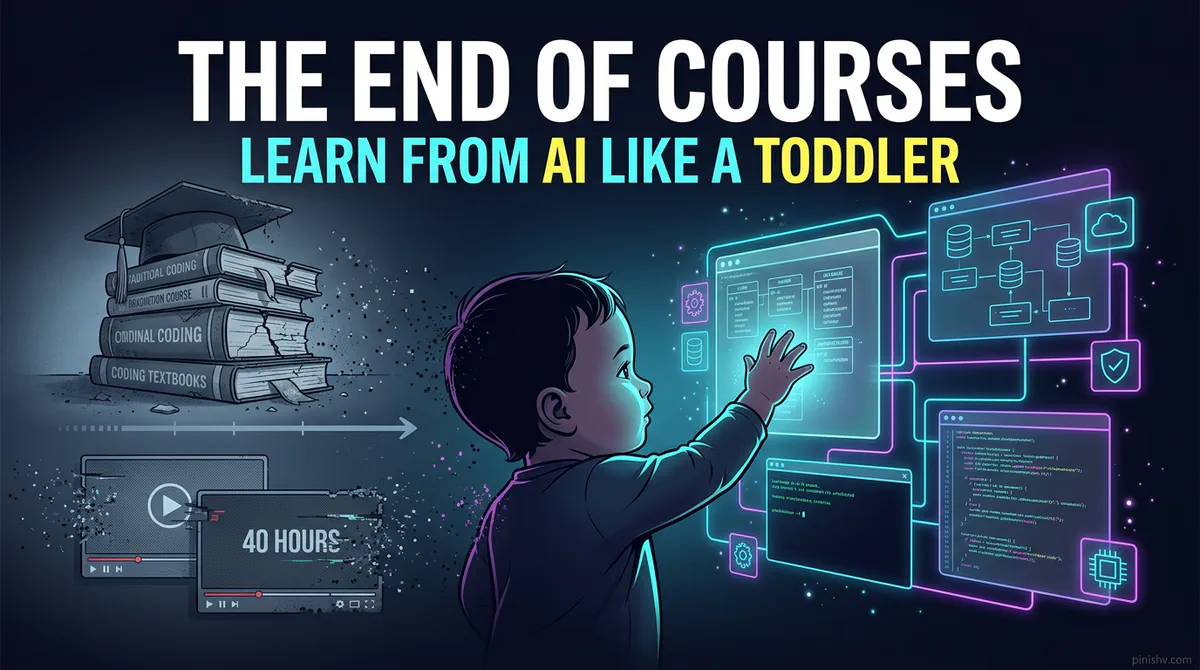
Remember when building an application required months of upfront learning? You’d buy a 40-hour video course, read through documentation, and painstakingly memorize syntax before writing a single line of logic.
Today, an AI agent builds that same application in three minutes from a single prompt.
We’re standing at a massive crossroads. Not just in software development, but in how humans acquire knowledge. And most people haven’t realized yet that the learning model they grew up with just flipped upside down. Theory used to come before practice. Now practice comes first, and theory arrives on demand. That’s a different game. We need to relearn how to learn.
What actually died#
Let me be precise, because this is the part that gets misread.
Courses didn’t disappear. Books didn’t disappear. The sequence did.
For twenty years the path was the same. Read the book. Buy the 40-hour course. Follow the tutorial. Build the toy project. Then, eventually, attempt something real. Learning was structured, linear, and almost entirely theory-first. That sequence is what broke.
An 8-minute deep-dive on a specific trade-off, delivered exactly when you need it, is actually more valuable than ever. Targeted, just-in-time learning is a superpower. What died is the 40-hour prerequisite. The idea that you have to load all the theory before you’re allowed to attempt anything real. The agent collapsed that runway to zero.
And the data is already catching up to what everyone can feel.
The coding bootcamp industry, the market that turned “learn to code in 12 weeks” into a multi-billion-dollar business, consolidated painfully through 2024 and 2025. Entry-level roles got automated or outsourced. Programs that didn’t rebuild around AI shut down. The survivors pivoted from “teach you to write code” to “teach you to work alongside agents.” On Udemy and Coursera, the courses people actually buy now have to be updated within the last 12 months or they’re teaching deprecated APIs. The half-life of “learned knowledge” collapsed.
But the deeper shift isn’t the market. It’s the cognitive model underneath.
I wrote before that AI didn’t change the work, it changed the sequence. The same thing is happening to learning. You’re no longer supposed to load the theory first and then apply it. You apply first, and the theory arrives on demand, exactly when you need it.
Learning is now intuitive, experiential, and strictly on-the-job.
Learn like a toddler#
Think about how toddlers learn to speak.
Nobody hands a two-year-old a grammar textbook. They don’t attend a workshop on verb conjugation. They hear words in context, try them, get corrected, try again. They absorb meaning through constant exposure, trial, error, and interaction with their environment. The adult in the loop isn’t delivering lectures. The adult is a patient partner who keeps responding, correcting, and raising the bar.
That’s exactly how we have to work with AI now.
There’s actual learning science behind this. Piaget’s stages of cognitive development put hands-on experience and interaction at the center of how humans build real understanding. A recent Springer paper on developmentally aligned AI argues that AI tools work best when they act as scaffolding, not substitution. Temporary support that strengthens the learner’s internal capacity and is gradually removed as competence grows.
Scaffolding means every time the agent generates something, you engage with it, understand it, and internalize what you didn’t know before. Substitution means the agent does it for you, and next time you need the same thing, you still can’t do it without the agent. Both look identical in the commit history. They feel completely different six months in.
This is the choice hiding in every single prompt.
As agents expose us to new architectures, libraries, frameworks, and design patterns on the fly, we have a choice: we can blindly accept the output, or we can choose to learn from it critically. I choose to learn. I choose to treat the agent, which has access to effectively all the knowledge available in the world, as a sparring partner for deep, on-the-job learning.
A sparring partner is different from a thinking partner. A thinking partner you lean on. A sparring partner pushes back. The first makes you weaker over time. The second makes you stronger. Pick the right one.
The crossroads: Operator vs. Kolboynik Architect#
Every developer right now is standing at the same fork. Two paths. Very different outcomes.
Path 1: The Operator (accept and ship)#
You accept exactly what the agent generated. You never interrogate the design. You never ask why this database, this pattern, this trade-off. You optimize for throughput.
Honestly? This is perfectly fine for a while. Nobody expects you to match the agent’s raw output speed or carry its encyclopedic knowledge of every framework. If your only goal is absolute scale (ship more, faster, cheaper), you can craft excellent skill.md files, feed the agent the right instructions, and trust it almost blindly to produce working applications. With a small asterisk, but you get the point.
But here’s the warning. If all you do is operate the AI and accept its outputs, you’re a prompt-runner. And a prompt-runner can, and will, be replaced by a motivated middle-schooler.
This isn’t hyperbole. The “prompt engineer” specialty, which was commanding serious salaries just two years ago, has effectively evaporated as a standalone role. Microsoft’s workforce surveys consistently rank it near the bottom of roles companies plan to add. The reason is brutal: as models got dramatically better at intent resolution, the gap between an “expert prompt” and a “decent prompt” shrank to almost nothing. The specialty evaporated because the skill stopped being scarce. Accepting output isn’t a career. It’s a commodity.
I’ve also written about this danger before: the quiet divide between AI operators (fast with prompts, lost when tools fail) and AI-augmented engineers (fast and capable of reasoning from first principles). Both look identical for six months. The gap between them compounds forever after that.
Path 2: The Kolboynik Architect (critical learning)#
If you want to stay relevant, you have to shift from coder to “Kolboynik”, the Hebrew term for the ultimate generalist who knows a bit of everything, about everything. Not a master of one domain. A master of connecting domains.
The market is already pricing this shift in. Industry analysis is showing a clear trend: demand for roles spanning multiple domains is climbing, while roles with a single narrow skill cluster are falling. The reason is painfully simple: narrow specialization is exactly what AI replicates most efficiently. Depth in one narrow thing doesn’t make you irreplaceable anymore. It makes you replaceable.
Generalists win because they do the thing agents are still bad at. Synthesizing across ambiguous, contradictory, unstructured problem spaces. Bridging systems. Catching second-order effects. Knowing which question to ask next.
Becoming a Kolboynik doesn’t mean you read every book in the library. It means you treat every agent output as a doorway into a new domain you now need to understand just enough to judge. Instead of treating the AI’s output as the finish line, you treat it as the starting point for a deep conversation.
Don’t dive into the lines of code. Zoom out.
- Question the design. Why did the agent choose this specific database structure? What alternatives did it silently reject? What would fail at 10x scale?
- Challenge the constraints. Ask it about security vulnerabilities, edge cases, cloud costs, compliance implications. Make it show its work.
- Interrogate the defaults. Every framework choice is an opinion. Every pattern comes with a cost. If you can’t articulate the trade-off, you don’t understand what shipped.
- Guide the process. The agent knows it should write tests. Reminding it sets the standard. Over time, it learns that test coverage is a non-negotiable part of what “done” means on your team.
This deep-dive conversation will probably take longer than the agent took to write the code in the first place. And that is exactly the point. You are the human in the loop, bringing judgment, context, and critical thinking to the table. Everything else got cheap. Judgment is the only thing still scarce.
The cost of skipping the conversation#
Here’s what the data says about developers who skip the deep-dive and just accept output.
A 2025 MIT Media Lab study found students using AI assistants showed measurably decreased neural engagement and less ownership over their work. Anthropic ran a randomized trial where developers learning a new library with AI scored 17 percentage points lower on mastery than those who learned without it. The biggest gap was in debugging. The one skill you most need when AI-generated code breaks.
More recent research has given this pattern names. Comprehension debt is the gap between how much code you’ve shipped and how much you actually understand. Cognitive debt is the gradual degradation of your team’s problem-solving capability from disuse. Intent debt is the loss of documented rationale in code and commits. The “why” that goes missing when the prompt is the only record.
A 2026 paper on cognitive offloading in agile teams found that AI-only planning significantly degraded risk capture rates. The teams performing best had a hybrid pattern: let AI do estimation and formatting, but require human deliberation for risk assessment and ambiguity resolution. The “boring” cognitive work is exactly the work you can’t offload.
And on the perception side, the numbers keep embarrassing us. Developers feel about 20% faster with AI. Objective measurement shows many of them are actually slower. I’ve referenced METR’s experienced-developer study before: 20% perceived speedup, 19% measured slowdown. The feeling is real. The feeling is wrong.
Karpathy, who literally hasn’t typed a line of code since December 2025, is the clearest voice on what replaces typing. Not passivity. Direction, taste, judgment, oversight, iteration. His own work on MicroGPT was explicitly designed “to demystify the algorithm so both humans and future agents can understand and extend it.” Even the person farthest along the agent curve is obsessed with understanding, not acceptance.
The developers who will compound in value over the next five years aren’t the ones shipping the most agent output. They’re the ones who, for every shipped feature, can also tell you exactly why it exists, what it costs, where it breaks, and what it looked like before they pushed back on the agent’s first answer.
What critical learning looks like in practice#
This isn’t abstract. It’s a set of small habits you either have or you don’t.
Pause after every accepted suggestion. Before merging an agent’s output, ask yourself one question: if the agent disappeared tomorrow, could I modify this confidently? If no, you haven’t learned anything from this PR. You just shipped borrowed knowledge.
Turn every unfamiliar pattern into a 10-minute tangent. The agent used an event-sourced pattern you’ve never seen? Stop. Ask it to explain why. Ask for two alternatives it considered. Ask for the trade-offs. Ten minutes of critical conversation now beats a 40-hour course later that you’ll never take.
Ask for the rejected options. “What did you consider before choosing this?” is the single highest-leverage prompt I use. It forces the model to expose trade-off space that it otherwise collapses into a confident recommendation.
Argue with the model on purpose. Even when it’s probably right. Especially when it’s probably right. The act of constructing a counter-argument is where your understanding actually forms. A sparring-partner workflow beats a thinking-partner workflow every time, for exactly this reason.
Keep a “things I didn’t know yesterday” log. One file. One line per learning. Review it weekly. It’s the cheapest learning system you’ll ever run, and it’s the closest replacement we have for the structured curriculum that just died.
Re-derive the answer without the model occasionally. The AI-off hours idea I wrote about earlier applies to learning, not just execution. Your mental models don’t build themselves. They atrophy unless you use them.
If that sounds slower than just shipping the agent’s output, it is. By design. Slower code path, faster growth curve. You’re choosing to invest the difference, not spend it.
The big picture#
We’re past the era where your value was measured by execution speed. Execution is the cheap part now. Generation is the cheap part. First drafts are free.
Your value is now determined by your ability to connect the dots, see the big picture, and deeply understand how systems behave together. It’s determined by the questions you choose to ask, the constraints you choose to enforce, and the second-order effects you choose to catch before they ship. The industry calls this being an AI Architect Programmer. I still prefer Kolboynik. Same idea. Less buzzword.
The good news is better than the bad news#
Here’s the part I want you to sit with, because it’s easy to miss under all the doom.
The barrier to becoming the best engineer you’ve ever been just collapsed.
Every architectural debate you used to need a senior colleague for? You can have it right now, unlimited, at 2 AM, at whatever depth you want. Every pattern you never got to work on because your team didn’t use it? You can build it, study it, and break it tonight. Every paper, every book, every framework you meant to read? You can now interrogate them chapter by chapter, with the author’s ideas pushed against your specific codebase, in your own words, at your own pace.
The agent is the best teacher any of us have ever had access to. Infinite patience. Infinite availability. Knowledge of every framework, paper, and pattern humanity has written down. No ego. No bad day. It will happily explain the same concept seven different ways until one of them lands.
The only thing it can’t do is decide to learn. That part is still on you. And if you decide to, the growth curve is steeper than anything that came before. Slower code path, faster growth curve. You were never in a better position to become a serious engineer than you are right now. That’s not hype. That’s the actual deal on the table in 2026.
So stop buying 40-hour courses you’ll never finish. Stop pretending that another passive video is the missing piece. The next “thing” ships in three minutes from someone else’s prompt. Your edge isn’t in consuming more theory. It’s in how deeply you engage with what’s already landing in your PRs every single day.
Stop learning syntax. Start learning architecture. The agent has all the answers. You are the only one who knows which questions to ask.
Which path are you on, Operator or Kolboynik? And what’s the last thing the agent taught you that you couldn’t have Googled? Find me on X, Telegram, or LinkedIn. I’d genuinely like to hear it.
Disclaimer: This article references specific studies, surveys, and public commentary for illustrative and educational purposes, including work from Anthropic, METR, MIT Media Lab, Microsoft Research, arXiv preprints, Andrej Karpathy, and industry analyses available at the time of writing. I have not independently verified all claims. The analysis and opinions expressed are my own. I have no financial interest, business relationship, or affiliation with any companies or tools mentioned. This is commentary, not investment, legal, career, or business advice.