
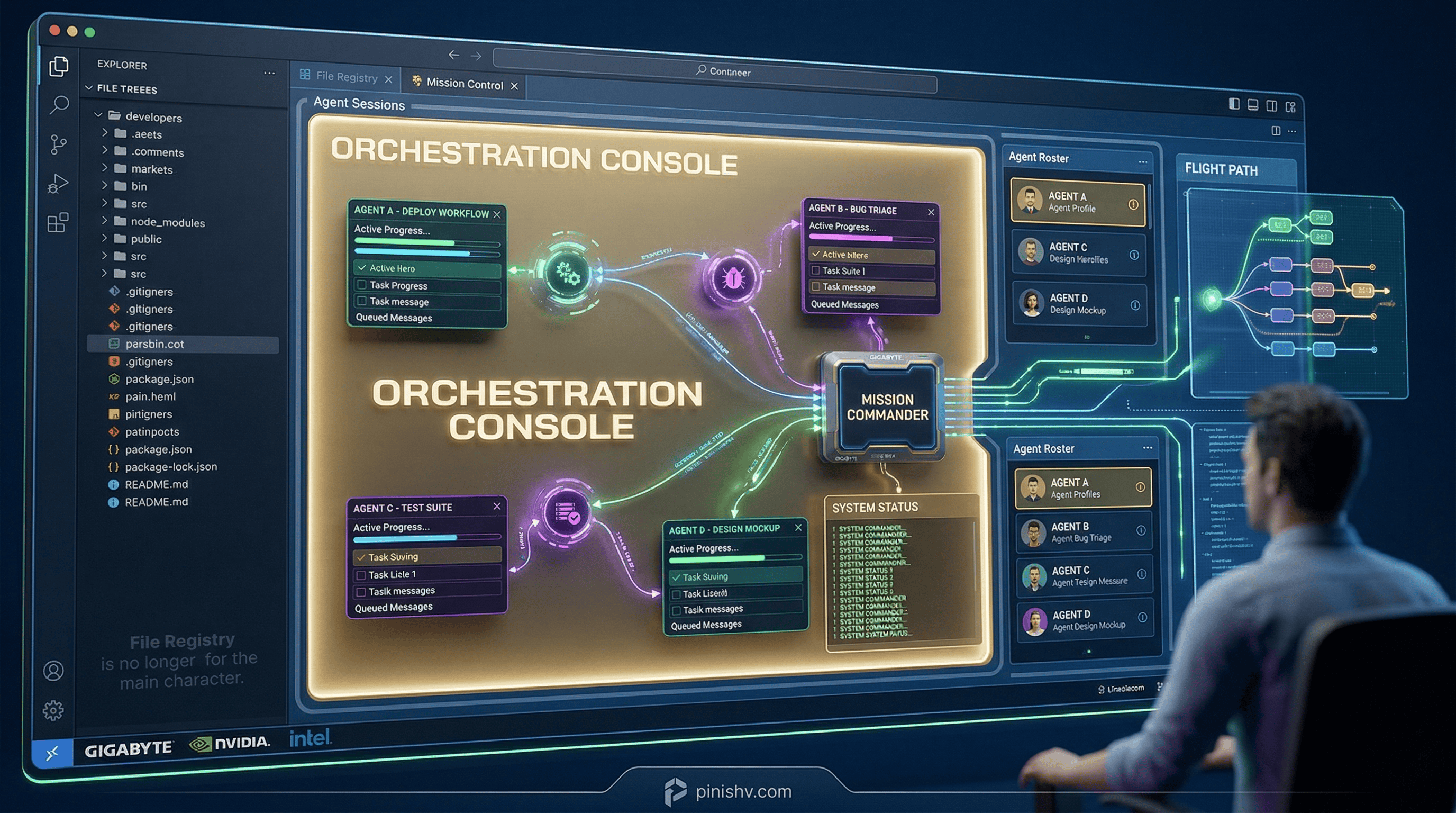

Something happened in the last few months that’s bigger than any single product launch.
Cursor 3 rebuilt its interface from scratch “centered around agents.” GitHub Agent HQ calls its control surface “mission control.” VS Code describes itself as “your home for multi-agent development.” JetBrains Air says the quiet part out loud: traditional IDEs add tools to the editor, while Air “builds tools around the agent.”
That’s not one company experimenting. That’s every major vendor converging on the same architectural shift.
The IDE is becoming mission control. The file tree isn’t disappearing. It’s just no longer the main character.
What actually changed#
I wrote about how AI IDEs work last year. Back then the story was three systems in a trench coat: autocomplete, context engine, agent harness. The editor was still the center. The AI was a feature bolted on.
That’s not what’s happening now. The center of gravity is moving. The primary surface is shifting from “navigate files and type code” to “assign, monitor, steer, and review agent work.”
Look at what the vendors are actually building:
Cursor 3 puts all local and cloud agents in one sidebar, including ones started from mobile, web, Slack, GitHub, and Linear. That’s closer to an operations console than a code explorer.
GitHub added an Agents tab directly inside repositories with a “mission control style view.” You choose from a fleet of agents, assign work in parallel, and track progress from any device. I covered Agent HQ when it launched. This is the next step.
Windsurf added parallel multi-agent sessions, Git worktrees, and side-by-side Cascade panes. Its vocabulary is plans, todo lists, queued messages, simultaneous cascades, and workflows. That’s orchestration language, not file navigation language.
Replit says the platform became “Agent-first.” Agent 4 adds parallel agents, visible task progress, and the ability to design while the agent builds in the background. That’s basically a kanban board fused with an IDE.
Firebase Studio describes itself as an agentic cloud-based development environment. But Google’s newer Antigravity is the one that says the quiet part out loud. Their tagline: “evolving the IDE into the agent-first era.” They explicitly frame it as: “the tools of yesterday focused on helping you write code faster; the tools of tomorrow need to help you orchestrate it.” That’s not an AI feature added to an editor. That’s a new product category.
Zed added Agentic Editing, third-party agents through ACP, and says the goal is switching between multiple agents without switching editors. Their roadmap includes subagent support and multi-agent collaboration.
Every one of these announcements uses the same vocabulary: agents, sessions, tasks, parallel work, orchestration, monitoring. Not files, buffers, tabs, and syntax highlighting.
Not everyone is moving at the same speed#
There’s useful nuance here.
VS Code and Zed are still fundamentally editors that are becoming multi-agent hosts. The file tree is still front and center. The agents are a powerful addition, but the architecture is additive.
Cursor, Windsurf, and Replit are further along. The center of gravity has shifted toward session and task management. The code is still there, but it’s becoming a drill-down surface rather than the starting point.
JetBrains Air and Google Antigravity are the clearest examples of vendors saying, explicitly, that the editor is no longer the thing the rest of the product is built around. Air exists specifically because JetBrains decided another editor wasn’t enough differentiation and killed Fleet to focus on agentic workflows.
That spectrum matters. If you’re evaluating tools for your team, know where on this axis you’re comfortable. Some teams want an editor that happens to run agents. Some want an agent platform that happens to have an editor. Those are different products for different stages of trust.
What this actually means#
This is a change in power structure.
For decades, the code editor held a monopoly as the primary surface of software development. You lived in it. Everything started there. The file tree was your map of the project.
That monopoly is ending. The editor is becoming one pane inside a larger agent-control system. You still need it. But you also need a task view, a session manager, an agent roster, a monitoring surface, and a way to review what shipped while you were doing something else.
I wrote about Cursor Automations triggering agents from events. I wrote about Claude’s computer use controlling your desktop from your phone. I wrote about DeerFlow orchestrating sub-agents in sandboxes. All of those are pieces of the same shift. The IDE is becoming the place where you manage all of it.
The engineers who adapt will treat their IDE the way a DevOps engineer treats a dashboard: a control surface for work happening across multiple systems, some of it human, some of it autonomous, most of it concurrent.
The ones who don’t will wonder why their editor feels increasingly like the wrong tool for the job.
How is your IDE workflow changing with agents? Still file-first or shifting to something else? I’d love to hear it. Find me on X or Telegram.