
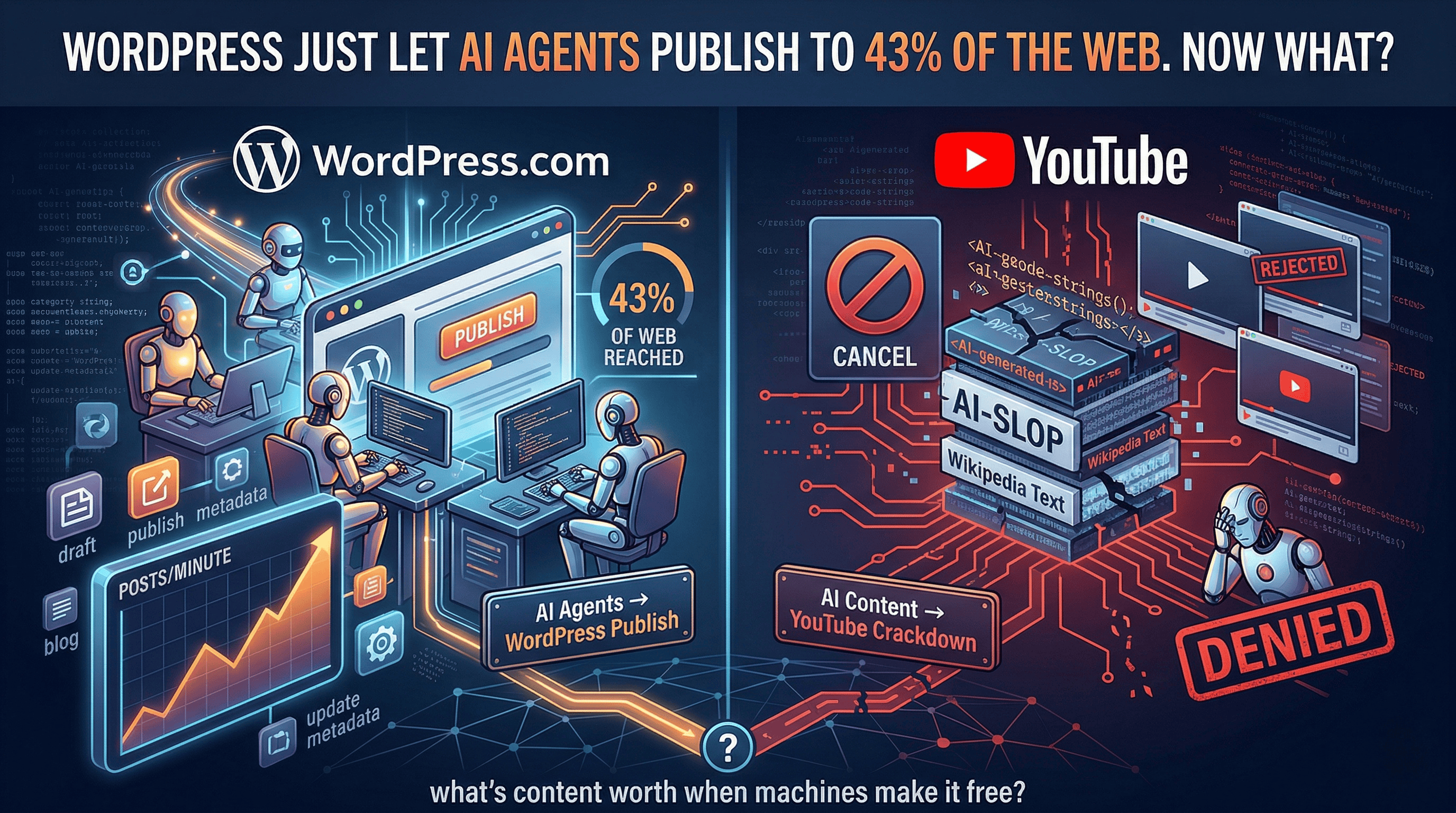

On March 20, WordPress.com announced that AI agents can now write, edit, and publish posts on any WordPress.com site through MCP. Not just draft. Publish. The agent can also manage comments, update metadata, fix alt text, organize tags, and read the site’s design system to match its visual style.
WordPress powers 43% of all websites. That’s 20 billion pageviews and 409 million unique visitors a month on the hosted platform alone.
They just gave AI agents a publish button to nearly half the web.
What it actually looks like#
You connect your preferred AI client (Claude, ChatGPT, Cursor, or anything MCP-enabled) through wordpress.com/mcp. Then you tell it what you want in natural language. “Write a post about our Q1 product updates, match our brand voice, schedule it for Tuesday.” The agent drafts it, formats it to your site’s design system, and publishes.
Posts default to draft status. All actions get tracked in the Activity Log. User role permissions are enforced: Contributors can draft but not publish. There are guardrails. But the core capability is clear: an AI agent can now autonomously manage a publication pipeline end-to-end.
This builds on MCP support WordPress introduced in October 2025, which was read-only at the time. The jump from “read my site” to “publish to my site” happened in five months.
Meanwhile, YouTube is going the other direction#
In January 2026, YouTube terminated 16 channels with a combined 4.7 billion views and 35 million subscribers. The reason: mass-produced AI content with little to no human involvement. Channels running AI voiceovers over Wikipedia articles. Fake movie trailers. Repetitive content with minor variations pumped out daily.
YouTube’s updated monetization policy is explicit: content with “little to no human involvement” doesn’t get monetized. YouTube CEO Neal Mohan said the platform “welcomes creators using AI tools to enhance storytelling” but draws the line at AI replacing storytelling entirely.
Two of the biggest content platforms on the internet. One just made autonomous AI publishing easier than ever. The other is actively punishing it.
What’s actually happening here#
The divergence makes sense when you look at what each platform values.
WordPress is infrastructure. It doesn’t care what you publish. It cares that you use WordPress to publish it. More content, more sites, more hosting revenue. Opening MCP write access makes the platform more useful for the agentic era. If AI agents are going to generate content at scale, WordPress wants to be the rails.
YouTube is an attention marketplace. It cares deeply about what gets published because its revenue depends on people watching. AI slop that nobody wants to watch degrades the product. YouTube has a direct financial incentive to filter, because advertisers don’t pay for content humans skip.
The difference isn’t philosophical. It’s economic. WordPress sells picks and shovels. YouTube sells eyeballs.
The SaaS connection#
I wrote recently about how the SaaS bargain is breaking. The old model was: rent generic software because custom is too expensive. AI collapsed the cost of custom. Same thing is happening with content.
The old model was: pay for a platform because creating and managing content at scale was hard. WordPress just made it trivially easy. An agent can maintain an entire content pipeline. So what’s the platform’s value when the hard part disappears?
WordPress is betting the value shifts from “helps you create content” to “is where content lives.” Infrastructure, not interface. That’s a defensible position if they’re right.
But the WordPress announcement and the YouTube crackdown point to the same underlying question: when content becomes nearly free to produce, how do you maintain quality? WordPress’s answer is “that’s your problem.” YouTube’s answer is “that’s our problem, and we’ll enforce it.”
For anyone building on either platform, the lesson is the same one from the SaaS article: the value isn’t in the generating anymore. It’s in the judgment, curation, and trust layer on top.
AI can publish to 43% of the web now. The question isn’t whether it will. It’s whether anyone will want to read what it publishes.
Experimenting with AI-driven content workflows? Seeing the quality shift on platforms you use? I’d love to hear what you’re noticing. Find me on X or Telegram.